

Pick up any camera, and you can take a photo. But understanding why that photo works (or doesn’t) is what separates someone who just presses buttons from someone who creates compelling visual content.
If you’re studying film, content creation, or any media course, you’ve probably realised that photography skills keep cropping up everywhere. Whether you’re framing a shot for a music video, creating thumbnails for YouTube, or building a visual brand on Instagram, the same core principles apply.
The exposure triangle: ISO, aperture, and shutter speed
If photography has a holy trinity, this is it. These three elements work together to control how much light hits your camera’s sensor and how your final image looks. Master these, and you’re well on your way to taking control of your camera.
ISO
ISO controls your camera’s sensitivity to light; a lower ISO (like 100 or 200) is less sensitive and produces cleaner, sharper images—perfect for bright daylight. A higher ISO (like 1600 or 3200) is more sensitive, allowing you to shoot in darker conditions, but it introduces grain or “noise” into your images.
Aperture
Aperture is the opening in your lens that controls how much light enters the camera. It’s measured in f-stops (like f/2.8, f/5.6, f/16), and here’s where it gets slightly confusing: a smaller f-number means a larger opening and more light. A larger f-number means a smaller opening and less light.
A wide aperture (small f-number like f/2.8) creates a shallow depth of field, where your subject is sharp but the background is beautifully blurred. A narrow aperture (large f-number like f/16) keeps more of the scene in focus, from foreground to background.
Shutter Speed
Shutter speed controls how long your camera’s sensor is exposed to light. It’s measured in fractions of a second (like 1/1000, 1/250, 1/30) or whole seconds for longer exposures.
Fast shutter speeds (like 1/1000) freeze motion, perfect for capturing action or sports. Slow shutter speeds (like 1/30 or slower) allow more light in but can create motion blur.
The key is understanding how all three elements work together. Change one, and you’ll likely need to adjust another to maintain the correct exposure. It’s a balancing act, but once it clicks, it becomes second nature.
Composition: The rule of thirds and beyond
Composition is how you arrange the elements within your frame, and it’s what separates a snapshot from a photograph.
The rule of thirds is the most fundamental composition rule, and it’s a great starting point.
Imagine your frame divided into nine equal parts by two horizontal lines and two vertical lines (most cameras can display this grid). The rule suggests placing your subject along these lines or at their intersections rather than dead centre.
It creates more dynamic, visually interesting images; a horizon placed along the bottom third line rather than through the middle creates more impact. A portrait subject positioned at an intersection point feels more engaging than one stuck in the centre.
It’s also important not to be afraid of empty space in your photography. Sometimes, what you leave out is just as important as what you include. Negative space can create mood, emphasise your subject, and give your images room to breathe.
Understanding light: The photographer’s most important tool
Here’s a truth every professional photographer knows: photography is about light. The word “photography” literally means “drawing with light,” and understanding how to see, shape, and use light is what transforms your work from amateur to professional.
Light can be hard or soft. Hard light (like direct sunlight at midday) creates strong shadows and high contrast; it can be dramatic but also harsh. Soft light (like an overcast day or light bounced through a diffuser) creates gentle shadows and is generally more flattering, especially for portraits.
Where is your light coming from? Front lighting illuminates your subject evenly, but can look flat. Side lighting creates texture and dimension. Backlighting can create silhouettes or beautiful rim light around your subject. Top lighting can create unflattering shadows under the eyes and noses.
Learning to see light means noticing not just where it is, but what it’s doing to your subject.
Focus and depth of field
What’s sharp and what’s blurred? This simple decision can completely change the story your image tells.
Shallow depth of field (achieved with a wide aperture) isolates your subject by blurring the background. It’s perfect for portraits, product photography, or any time you want to direct attention to a specific element.
Deep depth of field (achieved with a narrow aperture) keeps everything sharp from front to back. It’s essential for landscapes, architecture, or any scene where you want the viewer to see detail throughout the entire frame.
Understanding autofocus modes, focus points, and when to use manual focus gives you complete control over what your viewer sees and where their attention goes.
White balance: Getting your colours right
Our eyes automatically adjust to different light sources, so white looks white whether we’re indoors under tungsten bulbs or outside in daylight. Cameras aren’t quite so clever, which is where white balance comes in.
White balance tells your camera what “white” should look like under your current lighting conditions. Get it wrong, and your images will have an unwanted colour cast, too blue, too orange, too green.
Most cameras have automatic white balance, which works reasonably well most of the time. But understanding white balance presets (daylight, cloudy, tungsten, fluorescent) and knowing when to use them, or when to set a custom white balance, gives you accurate, professional-looking colours straight out of the camera.
Developing your photographer’s eye
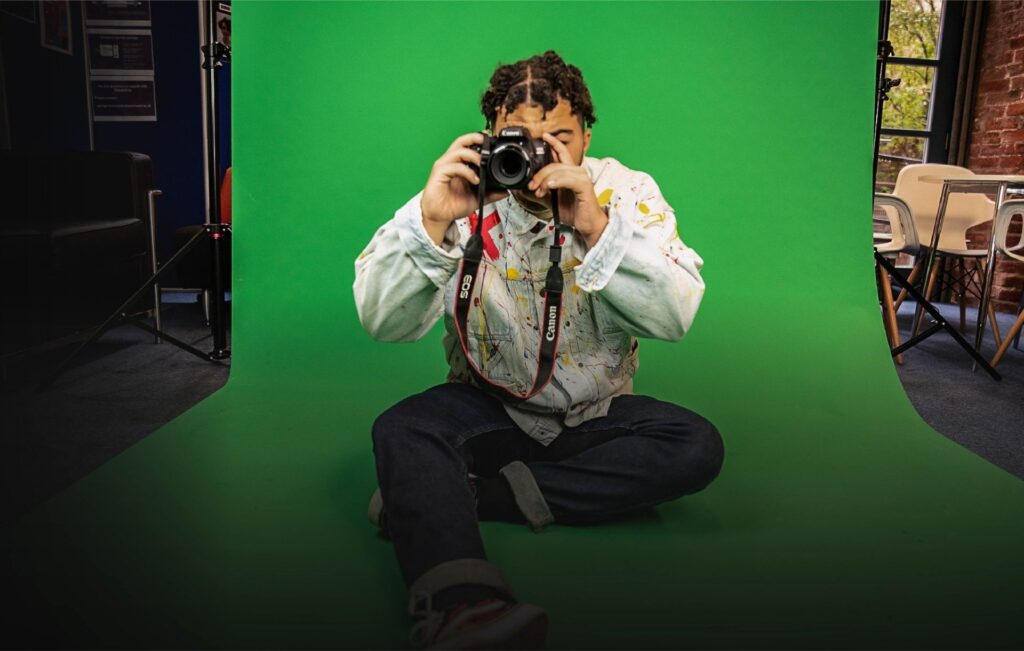
Here’s the thing about photography fundamentals: you can read about them all day, but they only truly sink in when you start practising them.
Understanding photography fundamentals isn’t just about taking better photos; it’s about seeing the world differently. It’s about understanding how images are constructed, how light works, and how visual choices affect meaning and emotion. These skills are invaluable whether you end up as a photographer, filmmaker, content creator, or anywhere else in the creative industries.
This is exactly what we focus on in our photography courses at Access Creative College. Our Level 2 Videography, Photography and Design course gives you a solid foundation in these essential skills, with hands-on experience using professional equipment and software. You’ll move beyond auto mode and start making conscious creative decisions with every shot you take.
For those ready to take it further, our Level 3 Film, Videography and Photography course develops advanced technical and creative skills, giving you access to high-quality cameras, photography studios, and professional-level editing suites. You’ll master the entire production process, from concept through to final delivery, using industry-standard tools and techniques.
You won’t just learn the theory of photography fundamentals, you’ll apply them on real projects, build a professional portfolio, and develop the visual literacy that underpins all great media work. The fundamentals we’ve covered here are just the beginning. With the right guidance, equipment, and opportunities to practise, you’ll develop from someone who presses a button to someone who crafts images with intention and skill.
Book an open day or apply to join one of our photography courses!